About Us
Artisan craft/ Small batch Certified Pure Maple Syrup
How it all started!
We purchased our property in 1971 and entered into a Managed Forest Agreement with the Ministry of Natural Resources on December 6, 1972. In 1973, we planted 30,000 trees, guided by a deep respect for the land, wildlife, and the responsibility of caring for the forest for future generations. Our work also supported wildlife habitat in partnership with Ducks Unlimited Canada.
In the spring of 2006, we joined the Forest Stewardship Council program through the Eastern Ontario Model Forest, strengthening our commitment to sustainable forest stewardship. As part of this journey, professional forester Tom Richardson walked the entire property with us and helped develop a long-term forest management plan rooted in sustainability and respect for the natural balance of the land.
While walking together, Tom asked why we were not tapping the maple trees behind the hunting camp. At the time, we believed there were not enough suitable maple trees. Tom helped us see the abundance that was already there. Through conversation and shared learning, he encouraged us to build a sugar shack and begin maple syrup production once our facility and equipment were ready.
Today, maple syrup production is part of our ongoing agreements with the Ministry of Natural Resources, the Eastern Ontario Model Forest, and the Forest Stewardship Council International Certification Program. More importantly, it is part of our commitment to land-based learning, sharing knowledge, and continuing traditions that bring community together on the land.


About Grampa-Chief's Maple Syrup
In 2007, our sugar shack was built by a local contractor using Lanark County wood supplied by our neighbour, LR McVeigh Lumber. Our Waterloo evaporator, made by Équipements Lapierre, was purchased and installed by local maple producer Springdale Farm Maple Products, helping us prepare to begin our maple journey on the land.
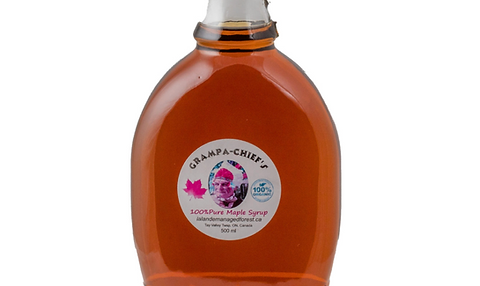
Lalande Managed Forest produced Grampa Chief’s Maple Syrup for the first time in winter 2008. That year, we tapped 100 trees and produced 55 litres of syrup. From the beginning, experienced volunteers shared knowledge, skills, and teachings. Land-based learning and traditional maple knowledge continue to guide how we harvest and produce our small-batch maple syrup.
Over time, as we listened, learned, and gained experience, our production grew. Today, we tap about 400 trees and produce an average of 230 litres each year.
Our sugar bush is supported entirely by volunteers. We are grateful for the many men, women, and youth who return year after year to help, learn, and share time together on the land. With support from the Ontario Maple Syrup Producers Association and grant funding, we launched our website and online sales program in 2021.
Maple syrup making has a much longer history on this land. In 2010, volunteer archaeologists uncovered an early evaporator and sap sled from the mid-to-late 1800s. These pieces now sit at our sugar shack as reminders of those who worked this land before us.
The historic evaporator, estimated to be 100–150 years old, shares similarities in shape to our modern Lapierre evaporator, showing how maple knowledge continues across generations.